Search for “best Japanese knife” and you will get a wall of recommendations, most of them written by people who have never stood in a Japanese kitchen. I live in Japan. I ran a traditional confectionery shop for thirteen years, which meant handling blades daily, and I cook at home for a family. What follows is the advice I would give a friend, not a ranking.
The short version: buy one gyuto or one santoku, in stainless, in the 60 to 150 dollar range, and spend the money you saved on a whetstone instead of a second knife. Everything below explains why.
- Only two shapes matter for your first knife
- Stainless, not carbon. This is the part people get wrong
- Decoding the steel names on the box
- Single bevel and double bevel, and why you want double
- What to spend
- The two things that will actually ruin your knife
- Sharpening is the actual skill
- What a Japanese knife will not do
- Where these knives are made
- If you are coming to Japan to buy one
- Your first week
- Buying from outside Japan
- One thing to do today
Only two shapes matter for your first knife
Japanese knife shops sell dozens of shapes. Almost all of them are specialist tools, and almost none of them should be your first purchase. For a first Japanese knife there are really only two candidates.
Gyuto
The gyuto is the Japanese take on the Western chef’s knife. Blades usually run 210mm to 270mm. That extra length gives you more cutting surface, which matters when you are slicing a large cabbage, portioning meat, or breaking down a fish. If you already own a Western chef’s knife and are comfortable with it, a gyuto will feel familiar on day one. It is thinner, lighter, and harder, but the motion is the same.
Santoku
The santoku is shorter, typically 160mm to 180mm, with a broader blade that tapers toward the tip. It is the knife most Japanese households actually own. Walk into an ordinary kitchen here and this is what is sitting in the drawer. The shorter blade suits smaller boards and smaller kitchens, which describes most homes in Japan.
The choice between them is close to a coin flip, and it comes down to your board more than your cooking. Measure your cutting board. If its shorter side is under 30cm, a 240mm gyuto will hang off the edge and you will resent it. Get the santoku. If you have a generous board and cook a lot of meat, get the gyuto.
What about the petty?
A petty is a small utility knife, 120mm to 150mm, for peeling, trimming, citrus, shallots, and detail work. It is genuinely useful and it is a superb second knife. It is a poor first knife, because it cannot handle a cabbage or a squash. Buy it later, when you know you want it.
Stainless, not carbon. This is the part people get wrong
A lot of enthusiast writing pushes beginners toward carbon steel because it takes a keener edge. That advice is not wrong about the edge. It is wrong about the person.
Carbon steel rusts. Not eventually, not if you neglect it for a month. It will discolour within a single session if you cut a tomato and walk away, and it will develop rust spots if you leave it wet in a sink overnight. In a professional kitchen this is fine, because someone wipes the blade between tasks out of habit. In a home kitchen, where you are cooking with one hand and answering a message with the other, it is a recipe for a ruined knife and a bad first impression.
Get stainless for your first Japanese knife. Modern Japanese stainless is very good. You will lose a small amount of edge retention and gain the ability to leave the knife on the board for ten minutes without consequence. For a first knife that is a trade worth making every time.
Buy carbon later, deliberately, when you already know you enjoy maintaining a blade.
Decoding the steel names on the box
Listings throw around codes like VG-10, AUS-10, SG2, Shirogami and Aogami as if everyone knows what they mean. Here is the practical version, which is shorter than the enthusiast version and more useful when you are choosing.
Stainless steels you will actually see
AUS-8, AUS-10, and similar. Softer, more forgiving, easier to sharpen, dulls sooner. Common at the lower end. Nothing wrong with these.
VG-10. The workhorse of the mid range and probably the most common steel in knives aimed at export. Holds an edge well, resists rust, sharpens without drama. If you buy one knife in your life, there is a good chance it is this.
SG2 / R2 powdered steels. Harder, hold an edge noticeably longer, cost more, and are less tolerant of clumsy sharpening. Excellent, but not a first knife.
Carbon steels, for when you get curious later
Shirogami, “white paper steel.” Very pure, takes a frighteningly keen edge, rusts if you look at it wrong.
Aogami, “blue paper steel.” White steel with additions that improve edge retention and toughness. Slightly more forgiving, still not stainless.
The names sound romantic and the differences are real, but they are small compared to the difference between a sharp knife and a dull one. Do not agonise over steel choice on your first purchase. A VG-10 gyuto that you sharpen every few months will outperform a fancy powdered steel knife that you never touch a stone to.
One more term worth knowing: san-mai, meaning three layers. A hard core steel is sandwiched between softer stainless cladding. This gives you a hard cutting edge with a body that is less brittle and easier to care for. Many knives in the recommended price range are built this way, and it is a sensible construction, not a marketing gimmick. The wavy pattern sometimes visible along the blade, often labelled damascus, is decorative cladding. It looks lovely and it does not cut better.
Single bevel and double bevel, and why you want double
Japanese knives come in two grinding traditions, and confusing them is the most expensive mistake a beginner can make.
Double bevel knives are sharpened on both sides, like a Western knife. Gyuto, santoku, petty, nakiri and bunka are all double bevel. They cut straight down and work for right and left handed cooks alike. This is what you want.
Single bevel knives are ground flat on one side and bevelled on the other. Yanagiba, deba and usuba are the well known examples, used for slicing sashimi, breaking down fish, and precision vegetable work respectively. They are magnificent tools in trained hands. They are also handed, meaning a right handed yanagiba is close to unusable for a left handed cook, and they steer sideways in the cut until you learn to compensate. Sharpening them properly is a different skill again.
If you have seen a beautiful long slender blade online and want it, understand what you are buying. A yanagiba is a sashimi slicer. It is not a general purpose knife and it will frustrate you if you treat it as one.
What to spend
The useful range for a first Japanese knife is roughly 60 to 150 US dollars. Below that you are usually buying a Western knife with Japanese branding. Above that you are paying for finish, handle materials, and the name of a smith, none of which cut better.
| Budget | What you are actually getting |
|---|---|
| Under $50 | Softer steel, thicker grind. Works, but you will not feel what makes a Japanese knife different. |
| $60 to $150 | The sweet spot. Hard stainless, thin grind, properly finished edge. This is where the experience lives. |
| $150 to $400 | Better fit and finish, nicer handles, more interesting steels. Real improvements, but incremental. |
| Above $400 | Craft, rarity, and aesthetics. Buy this because you want it, not because you need it. |
If you have 200 dollars total, do not spend it all on the knife. Spend around 90 on the knife and the rest on a whetstone and a cutting board. A 90 dollar knife that is sharp will outperform a 200 dollar knife that is dull, every single time, and every knife goes dull.
The two things that will actually ruin your knife
Neither of these is about the knife itself. Both are about what surrounds it.
Your cutting board
Japanese knives are hard and thin. That is the entire point of them, and it is also their weakness. Hard steel does not bend when it hits something unyielding. It chips.
Glass boards, stone boards, ceramic plates, and marble counters will destroy an edge. So will bamboo, which people assume is gentle because it is a plant. Bamboo boards are made from strips glued together, and the glue lines are harder than the fibre.
Use end grain wood if you can afford it, edge grain wood if you cannot, or a soft plastic board. In Japan the traditional choice is hinoki, a soft cypress that is kind to edges and smells extraordinary when wet. If you can find one, it is a pleasure to use, though it needs drying properly after each wash.
Your dishwasher
Do not put the knife in it. The heat is bad for the handle, the detergent is aggressive, and the blade will knock against other items during the cycle. Wash it by hand, dry it immediately, put it away. The whole process takes fifteen seconds.
Sharpening is the actual skill
This is the part most buying guides skip, and it is the part that decides whether you still like the knife in two years.
Every knife dulls. A Japanese knife dulls more noticeably than a Western one, because you got used to it being remarkably sharp. If you cannot restore the edge, the knife slowly becomes an expensive ordinary knife, and you conclude that the hype was overblown.
Do not use a pull-through sharpener. Those V-shaped gadgets grind a fixed angle into the blade and tear steel out of it. They are designed for softer Western knives and they will chew up a Japanese edge.
Get a combination whetstone, 1000 grit on one side and 3000 or 6000 on the other. A stone like this costs about 30 to 50 dollars and will last for years. The 1000 side does the real work. The finer side refines.
The minimum you need to know
Soak the stone until bubbles stop rising. Hold the blade at roughly fifteen degrees, which is about the thickness of two stacked coins under the spine. Push away from you with light pressure, working along the blade in sections. When you feel a slight burr along the whole length of the other side, switch sides and repeat. Finish on the fine grit with almost no pressure.
Your first attempt will be clumsy. Your fifth will be fine. It is a physical skill, not a knowledge problem, so reading more about it does not help. Start on a cheap knife if you are nervous.
What a Japanese knife will not do
It will not make you a better cook. It will make certain tasks pleasant that used to be annoying, and that is worth a great deal, but it is a different claim.
It will also not handle everything. Do not cut through bone with a gyuto or a santoku. Do not use it on frozen food. Do not pry with the tip. The thinness that makes it slice beautifully is exactly what makes it break under lateral force. If you need to go through a chicken carcass, use a heavier Western knife or a dedicated cleaver.
Where these knives are made
Japanese blade making is concentrated in a handful of towns, and each has a different history. This is not trivia. It tells you what kind of shop you are buying from.
Sakai, in Osaka, is the traditional centre for professional knives. The industry there is highly divided: one workshop forges, another sharpens, another fits the handle. A single knife passes through several specialists. Sakai leans toward single bevel knives for restaurant kitchens, though plenty of double bevel work comes out of it too.
Seki, in Gifu, has been making blades since the sword era and today produces at scale. Most of the well known Japanese knife brands that you can find in Western shops come from here. Seki is where craft meets manufacturing, which is exactly what you want at the price point I recommended.
Tsubame-Sanjo, in Niigata, is a metalworking region more broadly, known for tools and tableware as well as knives. Strong reputation for practical, well made everyday goods.
Echizen, in Fukui, is a smaller centre with a long forging tradition and a reputation among enthusiasts. Output is limited compared to Seki.
None of these is objectively the best. A well made Seki knife will outperform a poorly chosen Sakai one. But knowing the names lets you read a listing properly, and it tells you whether you are looking at a workshop or a factory.
If you are coming to Japan to buy one
Buying in person is genuinely better, because you can hold the knife, and handle feel is the one thing that does not survive a product photo.
The obvious destination is Kappabashi in Tokyo, a street of restaurant supply shops where several dedicated knife stores sit within a few minutes of each other. Osaka has a similar concentration near Sakai, and Kyoto has a number of long established shops. Ordinary department stores also carry good knives, often with less English support but no tourist markup.
Practical points
Tax free shopping. Many shops handle it for visitors. Bring your passport, and expect the purchase to be sealed or documented according to current rules. Ask before you pay, not after.
Engraving. Plenty of shops will engrave a name on the blade, often free or for a small fee. It usually takes anywhere from twenty minutes to a few days depending on how busy they are, so do not leave it to your last morning.
Getting it home. A knife cannot go in your cabin baggage. Check it in your hold luggage, wrapped properly, or have the shop ship it. Every year somebody loses a beautiful knife at a security gate for want of five minutes of thought.
Also, be honest with the shop about your experience level. Good knife shops are not trying to sell you the most expensive thing on the wall. Tell them you cook at home, tell them your board size, and let them point. In my experience they will steer you toward something cheaper than you expected.
Your first week
Two things surprise almost everyone.
The first is that the knife is sharper than you are used to, and your fingers do not know that yet. Slow down for the first few days. The guiding hand should be curled with fingertips tucked behind the knuckles. This is standard advice that people ignore until a knife this sharp makes the case for it.
The second is that a properly thin blade wants to be pushed or pulled through food, not chopped down onto it. If you are used to a heavy Western knife, you have been letting weight do the work. Here the edge does the work. Try a longer, more horizontal stroke and the difference becomes obvious immediately, especially on tomatoes and onions.
Buying from outside Japan
A few practical notes from this side.
Handles come in two families. The Japanese style handle, often octagonal or D-shaped, is light and usually made from wood fitted onto a tang. The Western style handle is riveted and heavier. Neither is better. The Japanese style shifts the balance forward, toward the blade, which many people find more precise once they adjust. If you are ordering online and cannot hold it first, the Western handle is the safer guess.
Sizes are given in millimetres, always measured along the blade, not the whole knife. A “210 gyuto” has a 210mm blade and is around 330mm in total.
Finally, check the shipping restrictions for your country before ordering. Some carriers and some destinations have rules about blades, and it is far better to discover this before you pay than after.
One thing to do today
Before you look at a single knife, go and measure your cutting board, and look at what it is made of. If it is glass, bamboo, or stone, buy a wooden or soft plastic board first. That purchase will do more for your cooking than any knife you could put on top of the wrong surface.
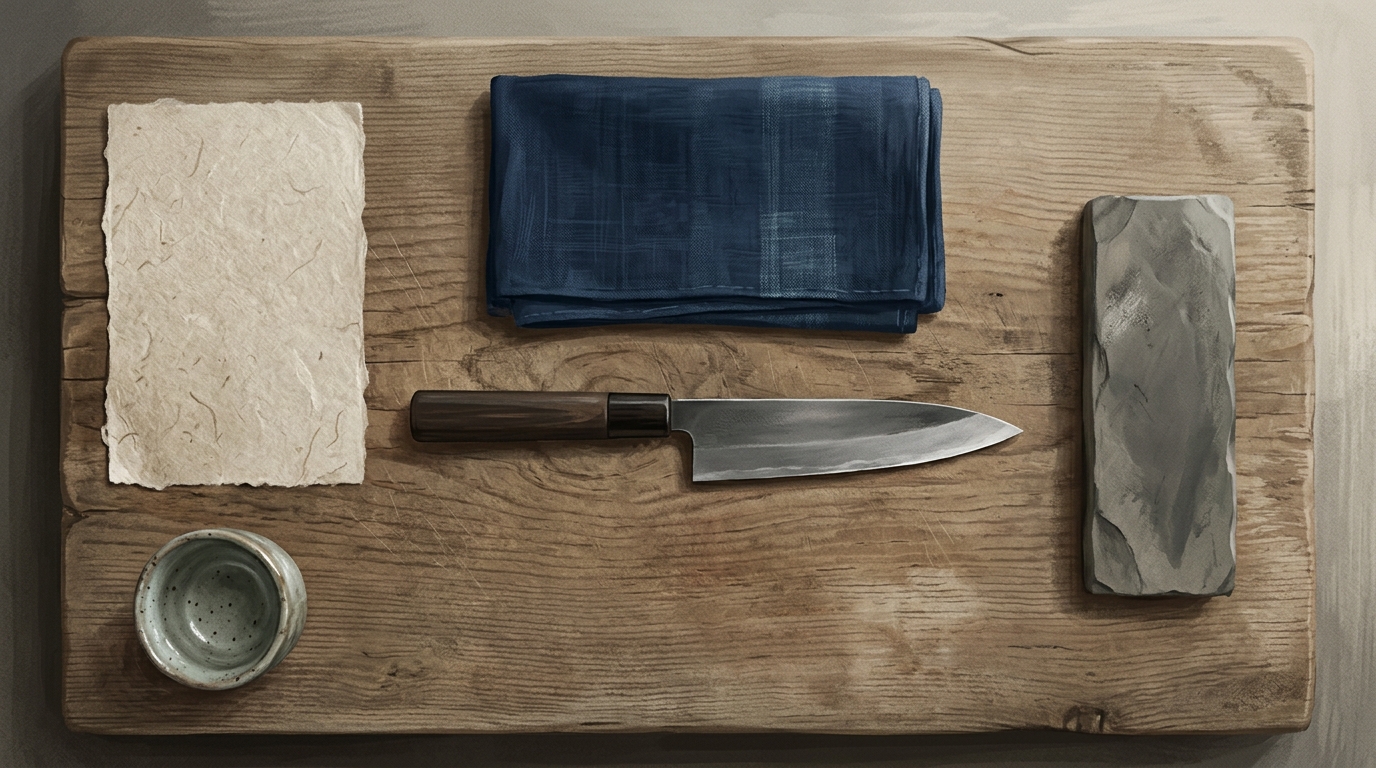
The featured image for this article was created with generative AI.
This article contains no affiliate links and no sponsored placements.

コメント